
Pediatric Dentistry (Pedodontics)

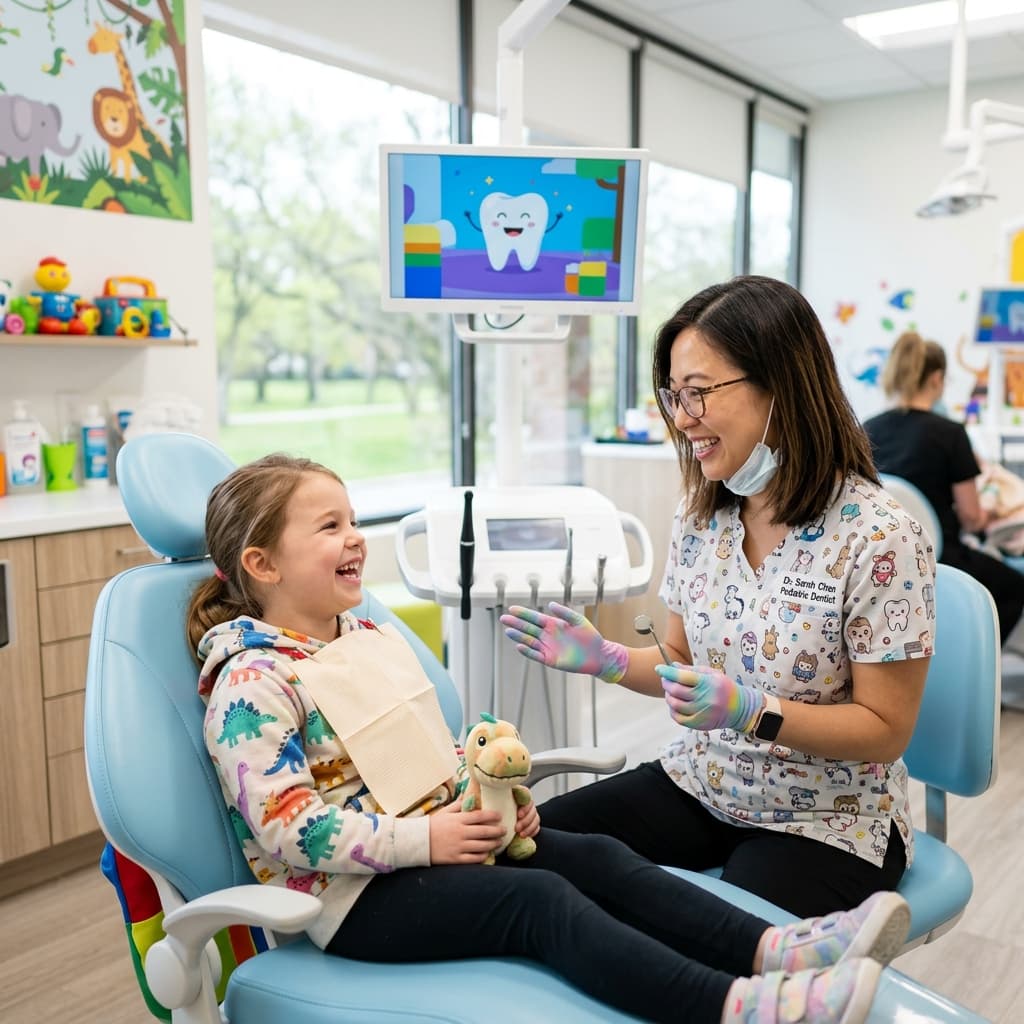
For ages 0-18, child-friendly dentistry is provided with preventive, therapeutic, and behavior-guided approaches.

Pediatric Dentistry (Pedodontics)

When Should a Child First Visit the Dentist?

The American Academy of Pediatric Dentistry (AAPD) and the European Academy of Paediatric Dentistry (EAPD) both recommend that a child's first dental visit should occur no later than 12 months of age — ideally when the first tooth erupts, usually between 6 and 10 months.

These early visits serve multiple purposes: they allow the dentist to assess oral development, identify any early signs of decay or structural anomalies, and — critically — help the child begin to associate the dental clinic with a positive, safe, and friendly environment. Research consistently shows that early first visits reduce dental anxiety, improve long-term oral health behavior, and lower lifetime treatment costs.

At DentARF, our pediatric dentist is specially trained in child psychology and behavior guidance techniques. Our waiting area is designed to be welcoming and age-appropriate, and we use a "tell-show-do" approach — explaining each instrument and step in child-friendly terms, demonstrating, and then proceeding — to build trust and reduce fear at every appointment.
Preventive Treatments for Children

Prevention is the cornerstone of pediatric dentistry. The most effective preventive treatments available are fluoride varnish applications and fissure (pit and fissure) sealants. Fluoride varnish is a concentrated fluoride gel applied directly to tooth surfaces 2–4 times per year in high-risk children. It dramatically reduces the rate of new cavities by strengthening enamel and inhibiting the bacteria that cause decay.

Fissure sealants are thin, protective coatings applied to the chewing surfaces of back teeth (molars and premolars), where the majority of childhood cavities occur. These surfaces have deep grooves and pits that trap food and bacteria even with diligent brushing. Sealants are placed without drilling, require no anesthesia, and significantly reduce the risk of pit-and-fissure caries for up to 5–10 years.

Regular professional cleaning and examination every 6 months provides the opportunity to remove calculus, reinforce oral hygiene instruction tailored to the child's age, apply preventive treatments, and monitor dental development including eruption sequence and occlusal development.

Treatment of Primary (Baby) Teeth

A common misconception is that baby teeth "don't matter" because they will eventually be lost. In fact, primary teeth are critically important: they maintain space for permanent successors, support proper speech development, enable chewing and nutrition, and contribute to facial bone development. Early loss of primary teeth due to untreated decay can lead to space loss, crowding, and the need for orthodontic treatment later in life.

Carious primary teeth are restored with tooth-colored composite fillings or stainless steel crowns (for severely broken-down teeth). When decay reaches the pulp, pulpotomy (partial pulp removal) or pulpectomy (complete pulp removal) — the primary tooth equivalent of root canal therapy — is performed to preserve the tooth until its natural exfoliation time.

When premature extraction is unavoidable, space maintainers are fitted to hold the gap and prevent adjacent teeth from drifting into the space — preserving the path for the permanent tooth to erupt correctly.

Pulpotomy & Root Canal Treatment

Pulpotomy (baby tooth pulp amputation) is performed when deep decay has partially affected the pulp. The coronal pulp is removed and the remaining radicular pulp is covered with a biocompatible material such as MTA, preserving the tooth until its natural exfoliation time. When the infection has spread into the root canals, a full pulpectomy (primary tooth root canal) is required — the canals are cleaned, disinfected, and filled with a resorbable material.

Preserving primary teeth through these treatments prevents premature space loss, maintains function, and protects the developing permanent dentition beneath.

Baby Tooth Extraction and Space Maintainers

When a primary tooth must be removed early due to severe decay, infection, or trauma, a space maintainer is fitted to hold the gap. Without it, adjacent teeth drift into the space, blocking or displacing the erupting permanent tooth — often leading to crowding and the need for orthodontic treatment.

Space maintainers can be fixed (cemented) or removable, and are custom-made for each child. They are a simple, cost-effective investment that can prevent far more complex treatment later.

Digital (Computerised) Anaesthesia

Digital anaesthesia systems deliver local anaesthetic at a computer-controlled, constant flow rate — dramatically reducing the discomfort of the injection itself. The controlled pressure and slow delivery allow the tissue to accommodate the solution with minimal sensation.

Compared to conventional syringes, children experience significantly less anxiety and discomfort. This technology is a cornerstone of our commitment to making every appointment as pleasant as possible.

Baby Tooth Crown Restorations (Steel / Zirconia)

Stainless steel crowns (SSCs) are the most durable and evidence-supported restoration for extensively decayed or pulp-treated primary molars. They fully cover the tooth, prevent fracture, and have the highest survival rates of any primary tooth restoration. They are placed in a single appointment.

Zirconia crowns offer a tooth-coloured alternative that is increasingly preferred for anterior teeth and aesthetically sensitive cases. They replicate the natural tooth colour and give both children and parents peace of mind about appearance.

Immature Permanent Tooth Treatment

Permanent teeth with incomplete root development (open apex) require specialist management when affected by decay or trauma. Apexogenesis (pulp preservation to allow continued root development) and apexification (inducing a calcific barrier at the apex) are the two main approaches, selected based on pulp vitality and the extent of damage.

Careful treatment planning, appropriate materials (MTA, calcium silicate cements), and regular follow-up ensure the best possible outcome for these vulnerable teeth.

Tongue & Lip Surgery (Frenectomy)

An abnormal lingual (tongue) or labial (lip) frenum can restrict movement, causing difficulty with breastfeeding, speech articulation, or oral hygiene. Frenectomy is a minor surgical procedure — often completed in minutes — that releases the tight attachment and restores normal function.

Post-operative healing is monitored closely; speech therapy or additional follow-up may be recommended where functional impact has been significant.

Dental Trauma Treatment

Children are particularly prone to dental trauma through falls, sports injuries, and accidents. Prompt management is critical: a knocked-out (avulsed) permanent tooth can often be reimplanted successfully if the patient reaches a dentist within 30–60 minutes. Parents should keep the tooth moist (in cold milk or saline) and seek emergency care immediately.

Our protocol follows IADT (International Association of Dental Traumatology) guidelines for all injury types — including avulsions, luxations, subluxations, and crown/root fractures — in both primary and permanent dentitions.

General Anaesthesia for Dental Treatment

For children with severe dental anxiety, very young age, extensive multi-tooth treatment needs, or special healthcare requirements, treatment under general anaesthesia may be the most appropriate option. All dental treatment is completed safely and comfortably in a single session, eliminating repeated stressful visits.

General anaesthesia is coordinated with a certified anaesthesiologist. DentARF ensures all necessary equipment, protocols, and safety standards are in place throughout the procedure.

Treatment with Rubber Dam & Magnification

Rubber dam isolation keeps the treatment field dry, clean, and free from saliva contamination — significantly improving the quality and longevity of fillings and root canal treatments. It also protects the child from accidentally swallowing instruments or materials.

Optical magnification (loupes or dental microscope) gives the clinician a far more detailed view of the working field, enabling more precise and thorough treatment. Together, rubber dam and magnification represent the gold standard for paediatric dental care.

DentARF Klinik

Take the First Step for a Healthier Smile Today

Use our online booking flow to create your appointment in 5 quick steps.

Book Appointment